
What if? From that single, simple question grew one of the largest and fastest High Performance Computing Clusters in the world.
Visionaries and Co-Founders, John Callahan and Chris Cox, both employees of the University of Nebraska, proposed the idea of a high performance computing center – and through their forward thinking and hard work, the vision was realized in The Holland Computing Center (HCC).
The HCC, located in the University of Nebraska’s Peter Kiewit Institute (PKI), is an innovative learning laboratory made possible by a significant lead gift provided by local businessman and philanthropist Richard Holland. Holland’s contribution to PKI has led to the creation of the largest educational computing resource in the history of Nebraska. The Center focuses on projects related to defense, life sciences, medicine, finance and higher education.
“Mr. Holland’s generosity has provided us with computing capacity that we could have only dreamed of 10 years ago,” said Winnie Callahan, executive director at PKI.
The HCC is capable of nearly 70 trillion processes per second (70 Tera-FLOPS). How fast is that? The supercomputer, named Firefly, could add the height, weight and age of every person on the planet together over 3,000 times per second. In addition to computing power, the Center features
fully donated American Power Conversion (APC) InfraStruXure data center configuration modules, which combine power, cooling, humidity control, rack management and security into one seamless solution. Along with APC, there are 936 companies world-wide who are partnered with PKI. Because of the innovative design achieved through these partnerships, PKI is a truly unique demonstration center and is larger than similar developments at Carnegie Melon University and Harvard Medical School.
According to Winnie Callahan, “This community – because of the desire to do it right – to build it forward for years to come, and to be able to create something everyone can be proud of, moved this Center forward.”
NMC Power Systems are the back-up to Success
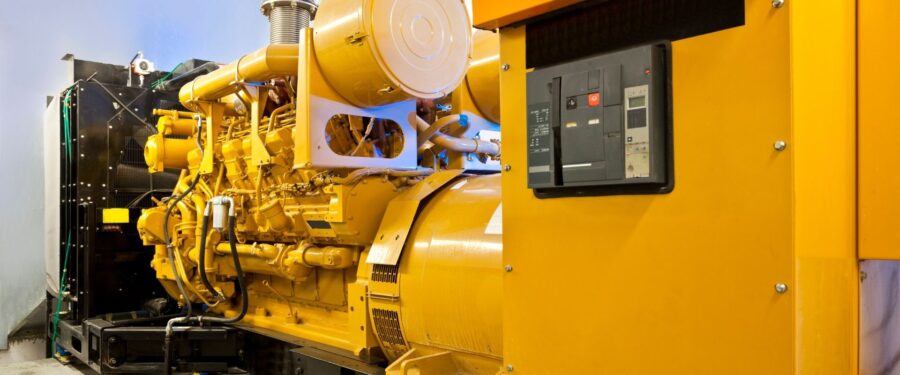
Essential to super-computing is reliable back-up power. As the electrical load for the supercomputer grew, the need for back-up power grew. Not only did the supercomputer require back-up power in case utility power failed, but the cooling systems also needed back-up power. Two Caterpillar genera-tors, a C15 450kW diesel generator and a C32 1000kW diesel generator, purchased through NMC Power Systems supplies this crucial back-up support power.
According to Winnie Callahan, “This computer equipment generates a lot of heat. If you have an electrical interruption to the power, in an extremely short period of time heat around those machines can soar. You have a chance of losing expensive equipment. When you think of generators and capability and reliability – you think of CAT.”
Working with Callahan on the generator project was Joe Stevens, Bob Morton, Ken Stenehjem, Tracy Henke and Ken Jones of NMC Power Systems. According to Callahan, “The whole group was so nice – and it kind of became a family.”
One thing that stands out to Callahan about NMC Power Systems is the ability to explain the equipment. “I have the utmost confidence – with NMC we’re buying experience, reliability and expertise,” she said. When asked if she’d recommend NMC to others, “Absolutely. The company by name, the product by name, and the individuals to contact. Absolutely.”
Firefly is currently ranked in the top 50 in the world and will rank in the top 20 with the addition of quad-core processors slated to be installed in early 2008.
“If you’re going to get into high performance computing or you’re going to do something significant – you should do it right and make the impact. Wanting to be the best you can be, wanting to keep the best and brightest in the state – that’s Nebraska. That’s Omaha. And isn’t that a good thing!” remarked Callahan.
“When you think of generators, you think of CAT.”
As the needs of PKI and The Holland Computing Center change and grow, NMC Power Systems will be there to provide the reliable back-up power they can count on. Just as certain, the Center will continue as a world leader in super-computing by continuing to look forward and by asking, “What if?”
Published in The Connection Volume 2 Issue 2